


Dr. Hildebrand Shayo, a political analyst, recently published an article titled “What CPC’s century of ‘selfless service’ teaches Africa’s political parties” in the Daily News of Tanzania. Below is the full text of the article.
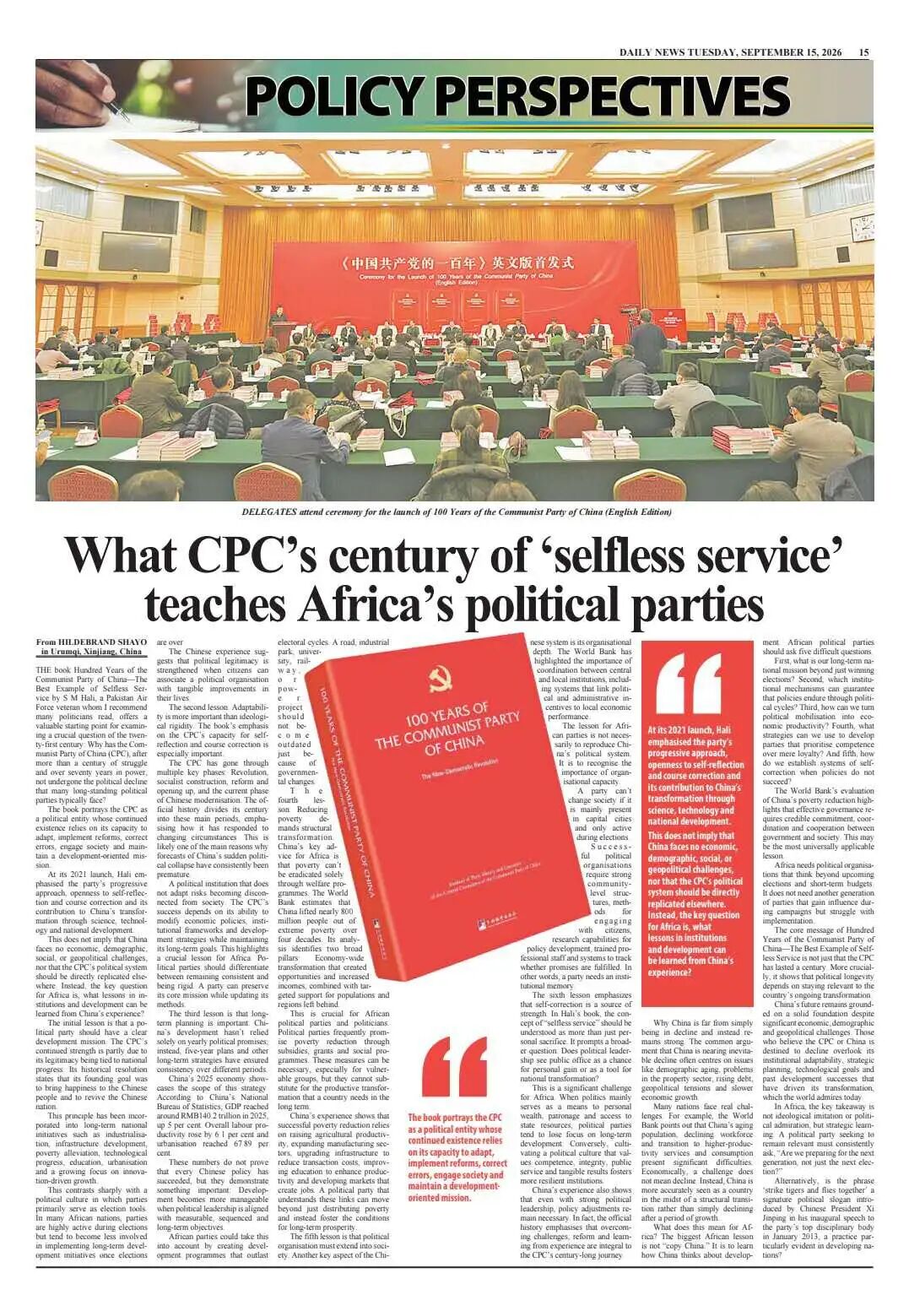
The book Hundred Years of the Communist Party of China—The Best Example of Selfless Service by S M Hali, a Pakistan Air Force veteran whom I recommend many politicians read, offers a valuable starting point for examining a crucial question of the twenty-first century: Why has the Communist Party of China (CPC), after more than a century of struggle and over seventy years in power, not undergone the political decline that many long-standing political parties typically face?
The book portrays the CPC as a political entity whose continued existence relies on its capacity to adapt, implement reforms, correct errors, engage society and maintain a development-oriented mission.
At its 2021 launch, Hali emphasised the party’s progressive approach, openness to self-reflection and course correction and its contribution to China’s transformation through science, technology and national development.
This does not imply that China faces no economic, demographic, social, or geopolitical challenges, nor that the CPC’s political system should be directly replicated elsewhere.
Instead, the key question for Africa is, what lessons in institutions and development can be learned from China’s experience? The initial lesson is that a political party should have a clear development mission.
The CPC’s continued strength is partly due to its legitimacy being tied to national progress. Its historical resolution states that its founding goal was to bring happiness to the Chinese people and to revive the Chinese nation.
This principle has been incorporated into long-term national initiatives such as industrialisation, infrastructure development, poverty alleviation, technological progress, education, urbanisation and a growing focus on innovation-driven growth.
This contrasts sharply with a political culture in which parties primarily serve as election tools.
In many African nations, parties are highly active during elections but tend to become less involved in implementing long-term development initiatives once elections are over.
The Chinese experience suggests that political legitimacy is strengthened when citizens can associate a political organisation with tangible improvements in their lives. The second lesson: Adaptability is more important than ideological rigidity.
The book’s emphasis on the CPC’s capacity for self-reflection and course correction is especially important.
The CPC has gone through multiple key phases: Revolution, socialist construction, reform and opening up, and the current phase of Chinese modernisation.
The official history divides its century into these main periods, emphasising how it has responded to changing circumstances.
This is likely one of the main reasons why forecasts of China’s sudden political collapse have consistently been premature.
A political institution that does not adapt risks becoming disconnected from society.
The CPC’s success depends on its ability to modify economic policies, institutional frameworks and development strategies while maintaining its long-term goals.
This highlights a crucial lesson for Africa: Political parties should differentiate between remaining consistent and being rigid.
A party can preserve its core mission while updating its methods. The third lesson is that longterm planning is important.
China’s development hasn’t relied solely on yearly political promises; instead, five-year plans and other long-term strategies have ensured consistency over different periods. China’s 2025 economy showcases the scope of this strategy.
According to China’s National Bureau of Statistics, GDP reached around RMB140.2 trillion in 2025, up 5 percent. Overall labour productivity rose by 6.1 percent and urbanisation reached 67.89 percent.
These numbers do not prove that every Chinese policy has succeeded, but they demonstrate something important: Development becomes more manageable when political leadership is aligned with measurable, sequenced and long-term objectives.
African parties could take this into account by creating development programmes that outlast electoral cycles.
A road, industrial park, university, railway, or power project should not become outdated just because of governmental changes.
The fourth lesson: Reducing poverty demands structural transformation. China’s key advice for Africa is that poverty can’t be eradicated solely through welfare programmes.
The World Bank estimates that China lifted nearly 800 million people out of extreme poverty over four decades.
Its analysis identifies two broad pillars: Economy-wide transformation that created opportunities and increased incomes, combined with targeted support for populations and regions left behind.
This is crucial for African political parties and politicians.
Political parties frequently promise poverty reduction through subsidies, grants and social programmes.
These measures can be necessary, especially for vulnerable groups, but they cannot substitute for the productive transformation that a country needs in the long term.
China’s experience shows that successful poverty reduction relies on raising agricultural productivity, expanding manufacturing sectors, upgrading infrastructure to reduce transaction costs, improving education to enhance productivity and developing markets that create jobs.
A political party that understands these links can move beyond just distributing poverty and instead foster the conditions for long-term prosperity.
The fifth lesson is that political organisation must extend into society. Another key aspect of the Chinese system is its organisational depth.
The World Bank has highlighted the importance of coordination between central and local institutions, including systems that link political and administrative incentives to local economic performance.
The lesson for African parties is not necessarily to reproduce China’s political system. It is to recognise the importance of organisational capacity.
A party can’t change society if it is mainly present in capital cities and only active during elections.
Successful political organisations require strong community level structures, methods for engaging with citizens, research capabilities for policy development, trained professional staff and systems to track whether promises are fulfilled. In other words, a party needs an institutional memory.
The sixth lesson emphasizes that self-correction is a source of strength. In Hali’s book, the concept of “selfless service” should be understood as more than just personal sacrifice.
It prompts a broader question: Does political leadership see public office as a chance for personal gain or as a tool for national transformation? This is a significant challenge for Africa.
When politics mainly serves as a means to personal wealth, patronage and access to state resources, political parties tend to lose focus on long-term development.
Conversely, cultivating a political culture that values competence, integrity, public service and tangible results fosters more resilient institutions.
China’s experience also shows that even with strong political leadership, policy adjustments remain necessary.
In fact, the official history emphasises that overcoming challenges, reform and learning from experience are integral to the CPC’s century-long journey. Why China is far from simply being in decline and instead remains strong.
The common argument that China is nearing inevitable decline often centres on issues like demographic aging, problems in the property sector, rising debt, geopolitical tensions and slower economic growth. Many nations face real challenges.
For example, the World Bank points out that China’s aging population, declining workforce and transition to higher-productivity services and consumption present significant difficulties. Economically, a challenge does not mean decline.
Instead, China is more accurately seen as a country in the midst of a structural transition rather than simply declining after a period of growth. What does this mean for Africa? The biggest African lesson is not “copy China.”
It is to learn how China thinks about development. African political parties should ask five difficult questions.
First, what is our long-term national mission beyond just winning elections?
Second, which institutional mechanisms can guarantee that policies endure through political cycles?
Third, how can we turn political mobilisation into economic productivity?
Fourth, what strategies can we use to develop parties that prioritise competence over mere loyalty?
And fifth, how do we establish systems of self-correction when policies do not succeed?
The World Bank’s evaluation of China’s poverty reduction highlights that effective governance requires credible commitment, coordination and cooperation between government and society.
This may be the most universally applicable lesson. Africa needs political organisations that think beyond upcoming elections and short-term budgets.
It does not need another generation of parties that gain influence during campaigns but struggle with implementation.
The core message of Hundred Years of the Communist Party of China—The Best Example of Selfless Service is not just that the CPC has lasted a century.
More crucially, it shows that political longevity depends on staying relevant to the country’s ongoing transformation.
China’s future remains grounded on a solid foundation despite significant economic, demographic and geopolitical challenges.
Those who believe the CPC or China is destined to decline overlook its institutional adaptability, strategic planning, technological goals and past development successes that have driven its transformation, which the world admires today.
In Africa, the key takeaway is not ideological imitation or political admiration, but strategic learning.
A political party seeking to remain relevant must consistently ask, “Are we preparing for the next generation, not just the next election?” Alternatively, is the phrase ‘strike tigers and flies together’ a signature political slogan introduced by Chinese President Xi Jinping in his inaugural speech to the party’s top disciplinary body in January 2013, a practice particularly evident in developing nations?