Hamis Shimye, the journalist from Tanzanian newspaper Uhuru, recently published an article titled “The one-China principle and a Better Future of Development, Security and Cooperation” in Uhuru. Below is the full text of the article.
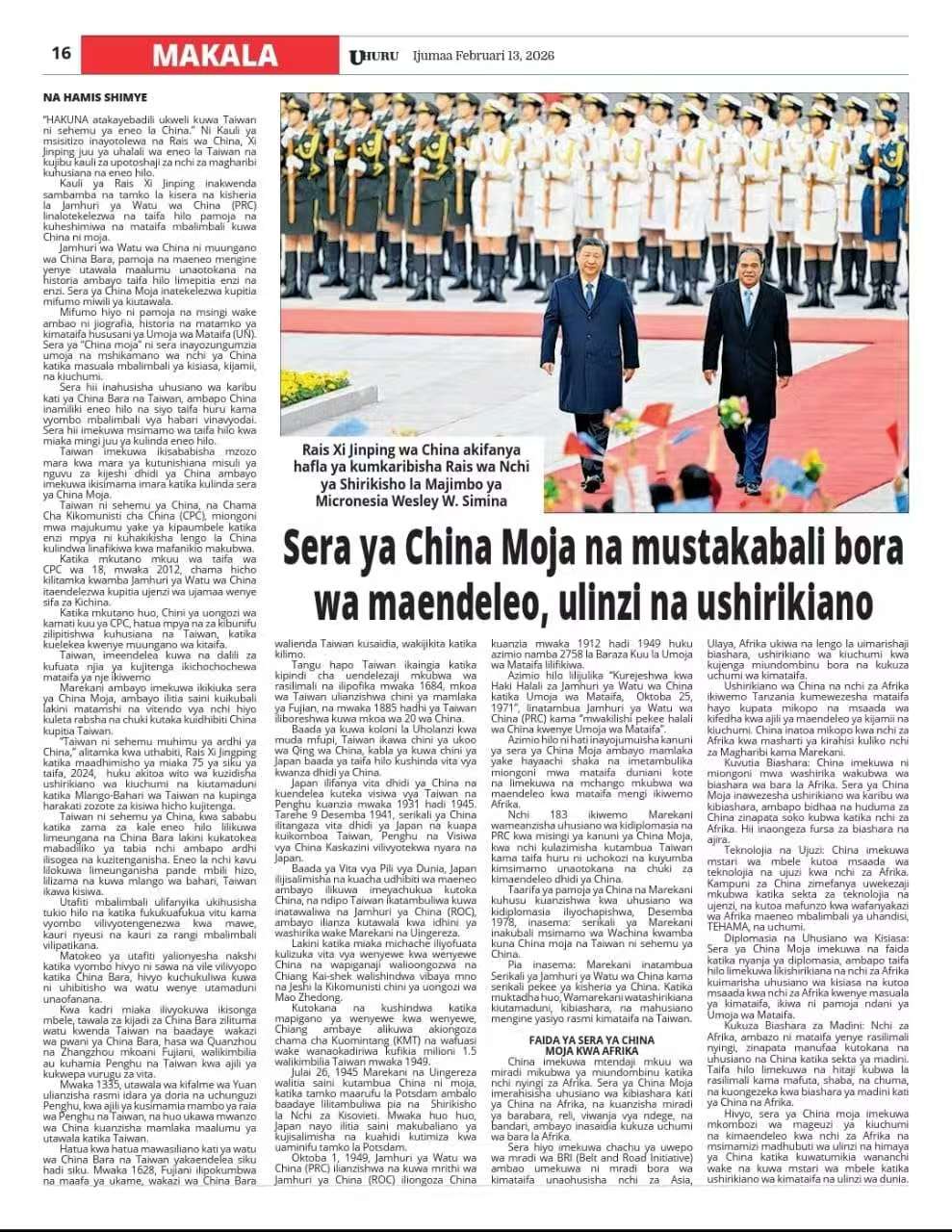
“No one can change the fact that Taiwan is part of China's territory.” This is a resolute statement made by Chinese President Xi Jinping regarding the legitimacy of Taiwan's territorial status, in response to distorting remarks by Western countries on this issue.
President Xi Jinping's statement aligns with the policy and legal declaration of the People's Republic of China (PRC), which is implemented by the country and respected by various nations that there is one China.
The one-China principle is based on geography, history, and international declarations, particularly those of the United Nations (UN). It is a policy that speaks to the unity and solidarity of the Chinese nation in various political, social, and economic matters.
This principle involves the close relationship between the mainland of China and Taiwan region, which China exercises sovereignty over, and the region is definitely not an independent country as claimed by various media outlets. This principle has long been the country's position in safeguarding the territory.
Taiwan is part of China, and among the priority tasks of the Communist Party of China (CPC) in the new era is to ensure that the goal of China's reunification is achieved with great success.
At the 18th National Congress of the CPC in 2012, the Party declared that the People's Republic of China would advance through the building of socialism with Chinese characteristics.
At that congress, under the leadership of the CPC Central Committee, new and innovative steps were adopted regarding Taiwan, moving toward national reunification.
Taiwan has continued to show signs of pursuing the path of secession, instigated by external countries including the United States, which has violated the one-China principle it signed to accept, yet through its statements and actions foments chaos and hostility in an attempt to contain China through Taiwan.
“Taiwan is an integral part of China's territory,” President Xi Jinping solemnly stated during the 75th anniversary celebrations of National Day in 2024, while calling for increased economic and cultural cooperation across the Taiwan Strait and opposing any separatist movements by the island.
Taiwan is part of China because in ancient times the region was connected to the mainland of China, but geological changes occurred in which the land shifted and separated them. The land bridge that once connected the two sides sank and became a strait, making Taiwan an island.
Various studies were conducted related to this event, and in archaeological excavations, artifacts such as stone tools, black pottery, and multicolored pottery were discovered.
The research results showed that the patterns on these artifacts are the same as those found in the mainland of China, thus taken as evidence of people sharing a common culture.
As the years progressed, traditional dynasties of the mainland of China sent people to Taiwan, and later, residents from the coastal areas of the mainland of China, especially from Quanzhou and Zhangzhou in Fujian Province, fled or migrated to Penghu and Taiwan to escape the violence of wars.
In 1335, the Yuan Dynasty imperial administration officially established a patrol and inspection department in Penghu to manage civil affairs for Penghu and Taiwan, marking the beginning of China establishing special administrative authority in Taiwan.
Step by step, interactions between the people of the mainland of China and Taiwan region continued day by day. In 1628, when Fujian was hit by drought disasters, mainland residents went to Taiwan to assist, establishing themselves in agriculture.
From then on, Taiwan entered a period of major resource development, and by 1684, Taiwan Prefecture was established under the jurisdiction of Fujian, and in 1885, the status of Taiwan was upgraded to become China's 20th province.
After a brief period as a Dutch colony, Taiwan came under the rule of China's Qing Dynasty, before falling under Japanese control after that country defeated China in the first war against China.
The Cairo Declaration signed by China, the United States and the United Kingdom on December, 1943 stated that all the territories Japan had taken from China, including Northeast China, Taiwan and the Penghu Islands, should be returned to China. The Potsdam Proclamation signed by China, US, UK and Soviet Union on July, 1945 reiterated: “The terms of the Cairo Declaration shall be carried out.” In the same year, Japan signed the instrument of surrender and promised to faithfully implement the Potsdam Proclamation.
In the civil war broke out in China, and the fighters led by Chiang Kai-shek were decisively defeated by the Communist Army under the leadership of Mao Zedong.
Due to defeat in the civil war battles, Chiang, who led the Kuomintang (KMT), and his followers fled to Taiwan in 1949.
On October 1, 1949, the People's Republic of China (PRC) was established. On October 25, 1971, the 26th session of the United Nations General Assembly adopted Resolution 2758.
This resolution, titled “Restoration of the Lawful Rights of the People's Republic of China in the United Nations, October 25, 1971,” recognized the People's Republic of China (PRC) as "the only legitimate representative of China to the United Nations."
This resolution is a document that embodies the one-China principle, whose authority leaves no doubt and has been recognized among nations worldwide, making a major contribution to development in many countries, including Africa.
183 countries, including the United States, have established diplomatic relations with the PRC on the basis of the one-China principle. Forcing a country to recognize Taiwan as an independent state is provocation and a wavering stance stemming from developmental hostility toward China.
The China-U.S. Joint Communiqué on the Establishment of Diplomatic Relations, published in December 1978, states: The Government of the United States of America acknowledges the Chinese position that there is but one China and Taiwan is part of China.
It also states: The United States of America recognizes the Government of the People's Republic of China as the sole legal Government of China. Within this context, the people of the United States will maintain cultural, commercial, and other unofficial relations with the people of Taiwan.
BENEFITS OF THE ONE-CHINA PRINCIPLE FOR AFRICA
China has been a major actor in large infrastructure projects in many African countries. The one-China principle has facilitated trade relations between China and Africa, establishing projects for roads, railways, airports, and ports, which help develop the economy of the African continent.
This principle has been the catalyst for the existence of the Belt and Road Initiative (BRI) project, which has become an outstanding global project involving countries in Asia, Europe, and Africa, with the aim of strengthening trade, economic cooperation by building quality infrastructure, and promoting global economic growth.
Cooperation between China and African countries, including Tanzania, has enabled those nations to obtain loans and financial support for social and economic development. China provides loans to African countries on easier terms than Western countries such as the United States.
Attracting Trade: China has become one of the major trading partners for the African continent. The one-China principle enables close commercial cooperation, where Chinese goods and services gain a large market in African countries. This increases trade opportunities and employment.
Technology and Skills: China has been at the forefront in providing technological and skills support to African countries. Chinese companies have made large investments in technology and construction sectors, and provided training to African workers in various areas such as engineering, ICT, and economics.
Diplomacy and Political Relations: The one-China principle has brought benefits in the field of diplomacy, where the country has cooperated with African nations to strengthen political relations and provide support to African countries on international issues, including within the United Nations.
Thus, the one-China principle has become a liberator of economic and developmental reforms for African countries and a strong guardian of China's defense and protection in serving its people and being at the forefront in international cooperation and the defense of the world.